
Drive-In Double Feature: Scream 4 & Evil Dead (2013)!

paparo

Anthony is a friend from Chicago whom I have had many talks about horror with; the ones that immediately come to mind seem to circle around Rob Zombie’s House of 1000 Corpses and The Devil’s Rejects if memory serves correctly — but there’s a very good chance it doesn’t.

Now Anthony claims he had never written anything for a site before, but he did such a stellar job with this write up that I think he may have just been pulling my leg. He knocked this one out of the park! And I’m not afraid to pay him the compliment, even if he is a fan of modern horror remakes. But enough of my yammerin’: take it away, Anthony!

I have a confession to make, and it’s something which will probably take away any sort of credit I may ever hope to have as a horror fan: I absolutely love remakes of classic horror movies.  Whether it’s 2004’s Dawn of the Dead, Rob Zombie’s Halloween, or the modern takes on Friday the 13th and Texas Chainsaw Massacre.  It doesn’t matter if it’s a remake done with input by the original creators, hoping to realize their vision more clearly after a few decades of technology improvements or if it’s a remake by an entirely new crew, attempting to put a new spin on a beloved movie.  I just really like seeing brand new takes on a movie that I already know and love, for better or for worse!

With this in mind, there’s a very specific sub-section of remakes that holds a special place in my heart, and one that I think would make a really fun focus for a drive-in double feature.  That is, of course, the remakequel.  A movie which manages to both retell key elements of the original film, but also takes place in a universe where the original story did, in fact, happen!  It’s an interesting slice of movie-making which can serve to magnify the themes of the original film, while also paying due respects by not wiping the old story out of continuity to make room for the new story.

My two favorite remakequels in recent memory are Scream 4, from 2011, and Evil Dead from 2013.  Both of these films simultaneously serve as the fourth movie in their respective series, while also acting as a remake/reboot of the original film.  It’s hard to talk about these two movies without first going a bit into the original versions!  Both of these film franchises are widely known and loved, and for similar reasons.  Throughout the ‘80s and early ‘90s, Sam Raimi’s Evil Dead trilogy managed to combine over-the-top campy gore with slapstick comedy, to create a unique blend of horror and dark comedy.  This combination resonated throughout the horror film industry, and the influences can be seen in countless movies released afterwards.  Similarly, the Wes Craven created Scream films took a more light-hearted approach that managed to bring campy slasher flicks back from the dead in the mid-to- late ‘90s.  While I think many people going to see this double feature would be familiar with the original franchises, I don’t think that quite as many people went and saw the fourth movies in these series, and that is why I would love to attend a double-feature playing both films!
scream4

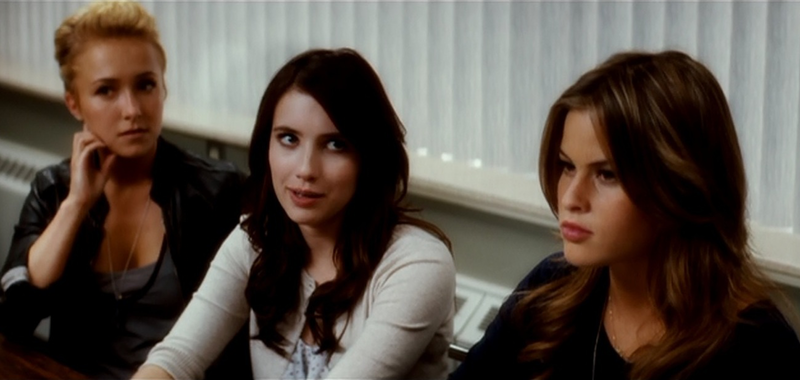
The first movie played would have to be Scream 4, as that movie not only came out first, but thematically sets up the idea of a remakequel in the classic self-aware style which made the first movie so entertaining!  Taking place 15 years to the day after the original Scream film, this movie sees the town of Woodsboro dealing with what appears to be a copycat killer, mirroring the acts of the infamous Ghostface.  The two main characters that this film looks at are Neve Campbell, reprising her role as Sidney from the first three films, and newcomer Emma Roberts playing Sidney’s younger cousin, Jill.  In examining the relationship between the “final girl” from the original film, and her family member who is set up to fill that archetype in this one, Scream 4 provides a really fun and twist-filled analysis of the slasher film sub-genre, and of the craze of remaking classic horror films in general.  The movie plays with our expectations by giving the audience a mix of exactly what they expect in some instances and exactly the opposite of what they expect in others, keeping this tension high and never letting the viewer have a moment to feel comfortable!  Scream 4 serves as both a great example of a remakequel done right, and also as a fourth-wall breaking explanation of exactly what it means to have a reboot take place in the same universe as the original films.  Opening with Scream 4 will surely delight the crowd attending this double feature, and will also help set the scene for the second movie.
ed

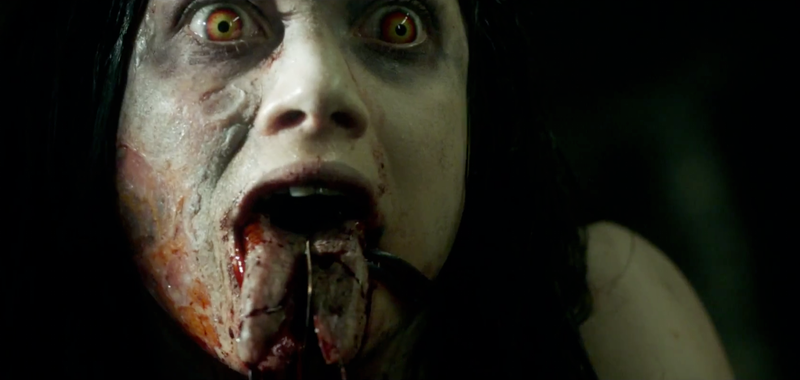
Next up, we have Evil Dead!  This movie is a bit vaguer in its relationship to the original trilogy than Scream was, but if you pay attention it definitely can be viewed as “Evil Dead 4.”  I think this is awesome, because Evil Dead 2 was actually one of the earliest examples of a remakequel!  Taking place some 20 years after the original, this Evil Dead introduces us to a brand new set of 20-somethings who end up spending the week in the exact same cabin in the woods featured in the original trilogy.  Our two main characters are Jane Levy and Shiloh Fernandez as Mia and David Allen.  The brother-and-sister duo breaks the audience’s perception on how this remake is going to run, both immediately and in unexpected ways throughout the film!  At first, it appears that David might be this movie’s “Ash.”  They wear practically the same outfit, and both are accompanied by a sister, a girlfriend, and a few other friends.  But as the film goes on, we start to see elements of Ash appear in nearly every main character, but mostly Mia.  This switch-up serves to remind us that, despite the events being very similar to the first movie, this is more than just a remake.  Furthering this idea, it’s worth noting that the theme of cycles being both broken and re-entered runs throughout the entire film.  From the main purpose of the trip being Mia trying to break her drug habit, to the climactic reveal that (despite what we were shown previously in the series) the Necronomicon won’t go away just because it’s been set on fire.  This movie manages to pay homage to the best parts of the original Evil Dead trilogy, without ever feeling like a rehash!  Also, by going a bit lighter on the comedy and a bit heavier on the atmosphere, at times it manages to do something that the originals themselves never really did: scare the audience.  The use of practical effects and having a full cast of really believable actors, this film accomplishes everything that an Evil Dead movie should accomplish, and is a must-see for any fans of the series.

With that, the double feature will end, hopefully giving anyone who sat through the whole thing a lot to think about, and a couple of modern remakes that aren’t so bad after all.  Scream 4 and Evil Dead are two of my favorite modern horror films, and movies that I fear many people skipped due to the concern of them being creatively bankrupt unoriginal rehashes of old movies.  Were these two movies to ever actually get shown together, my biggest hope would be to show the world of horror fans that you can do a reboot right!  Some stories are so good that they’re worth telling again.

Anthony is void of any major forms of social media or public blogs, but any praise and/or criticisms can be left here and I’ll be glad to pass it along to him!

Stephen King’s Dollar Babies!

Den of Geek wrote a similar article on the same topic recently. To clear up any concerns I’ve included a disclaimer/clarification after this article if you’re interested.*

king

If you’ve never read Stephen King’s On Writing: A Memoir of the Craft – a quintessential text for any aspiring writer and/or creative type – I highly suggest checking it out ASAP from your nearest lie-berry. Even if you’re not at all interested in writing, the book still works as an amazing autobiography, detailing every part of King’s life – from his earliest memories growing up to his first successes an an author.

And that’s one of the truly amazing parts of the book: we witness him go from a nobody to a somebody after years of busting his hump. King and his wife Tabitha (Tabby, to Steve) were married with a newborn on their hands, struggling to make ends meet. He was teacher and grading papers during the day, and writing his stories at night. And after chipping away at it long enough – and nearly almost giving up – Carrie was finally published, and the rest is history. King is humble and forthright in On Writing – he makes no airs about the fact that he’s since made boatloads of money and doesn’t need to write another book for the next few millennia. But he’s a writer in the truest sense: he writes because he’s so passionate about it; he can’t do anything else.

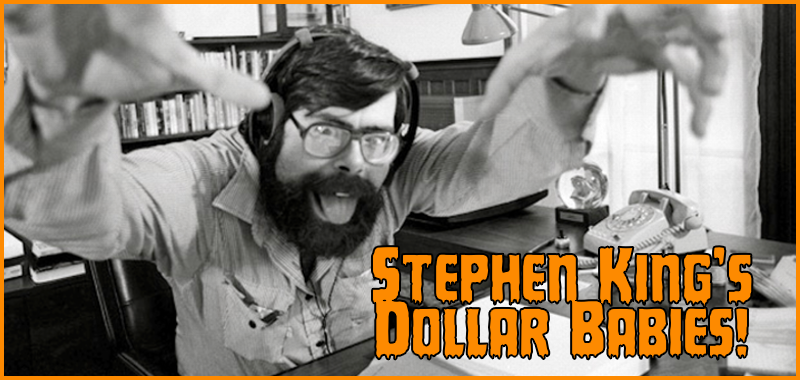
So it was with this understanding of being utterly devoted to creating works of art – combined with the fact that he didn’t really need any more money – that King began allowing aspiring film makers the right to film any of his short stories… for one dollar. He labeled these projects his “Dollar Babies“.

By the late 1970s King had amassed a large collection of short stories, and after the successes of his full length novels Carrie, ‘Salem’s Lot, and The Shining, he started receiving correspondence from college-aged film makers hoping to adapt a piece of his work. As King tells it:

Around 1977 or so, when I started having some popular success, I saw a way to give back a little of the joy the movies had given me. ‘77 was the year young film makers – college students, for the most part – started writing me about the stories I’d published, wanting to make short films out of them. Over the objections of my accountant, who saw all sorts of possible legal problems, I established a policy which still holds today. I will grant any student filmmaker the right to make a movie out of any short story I have written, so long as the film rights are still mine to assign. I ask them to sign a paper promising that no resulting film will be exhibited commercially without approval, and that they send me a videotape of the finished work. For this one-time right I ask a dollar. I have made the dollar-deal, as I call it, over my accountant’s moans and head-clutching protests sixteen or seventeen times as of this writing [1996].”

So with those simple rules in place, students and ambitious directors were allowed to have at it. The professionalism on these projects covered both ends of the spectrum, from hundred-dollar cheapies shot on VHS, to big-budgeted badboys like the adaptation of Umney’s Last Case, which was shot on 35mm film for over $60,000.

Some of these little labors of love would end up being launching pads for soon-to-be award winning directors. So let’s look at a few of the first Dollar Babies ever produced, and the teams behind them.

boog

The Boogeyman is the first Dollar Baby to be produced. Released in 1982 (based on a story written by King in 1973), it was directed by Jeffrey C. Schiro who would later get into TV, directing an episode of Tales from the Darkside. It had a budget of a whopping $20,000! In 1982, that was practically a million bucks. While Schiro and his crew didn’t go on to do much more after this little flick, the seeds were planted for an exciting new venture with endless possibilities.

crow

This 30 minute short came out in 1983 and was based on King’s 1977 short story, Children of the Corn. This is where things get interesting: in the beginning of King’s career, there was really only interest from major movie studios in his full length novels, which is why he allowed budding auteurs to adapt his shorter works for only a dollar. While not necessarily a loophole, it did allow a fortunate few to be the first to adapt what would later become major motion pictures. Disciples of the Crow was the first instance of this, but it wouldn’t be the last.

woman

Perhaps the most prominent and significant of all the entries, The Woman in the Room was not only Frank Darabont’s first film but also technically the first Dollar Baby. A 20-year-old Darabont, who wasn’t even involved in the movie industry at the time, loved the story so much that he wrote King a letter asking if he could make a short film of it. King, keen on conceptualizing a way to allow this put into action the Dollar Babies. It took Darabont over 3 years and $35,000 to complete the film, making his entry third on the list – but he was the first one to approach King with the idea back in 1980. King went on to say it was, “Clearly the best of the short films made from my stuff.” So good, in fact, that Darabont and his crew entered it for Oscar consideration in the short film category. It even ended up being purchased (along with The Boogeyman and Disciples of the Crow) for release on home video. It would be the beginning of a long and successful career for Darabont, who would end up adapting several more of King’s works – The Mist, The Green Mile – and would eventually win the Oscar for Best Picture (as well as pretty much every other category) for The Shawshank Redemption – which of course, was based on a short story by Stephen King.

mower

Last on the list, we have the whole reason I wrote this piece: The Lawnmower Man. I was surfin’ the net as kids are wont to do these days, when I fell down one of those rabbit holes – the deep and endless kind where one click leads to another click, leads to another, and another; from Wikipedia, to Youtube, and back again. Link to link to link. I’d somehow found myself watching what I thought was some cheapo home movie on Youtube simply entitled The Lawnmower Man. And I wasn’t entirely wrong: it is a cheapo homemade movie, and it is entitled The Lawnmower Man. But what I didn’t realize until seeing the opening credits was that it was indeed based on Stephen King’s short story of the same name.

Most notable is the fact that this short film is more faithful to its source material than 1992’s big-budgeted take on the story, which bears absolutely no resemblance to King’s work other than in name. Pretty impressive: some anonymous students with $5,000 did a better job of adapting a Stephen King story than Hollywood could with 10 million smackers.

And that’s the beauty of the crossroads where determination, creativity, passion and respect intersect. King is an artist – once a very struggling artist – and he knows what it’s like to have that fire burning so badly in your belly; nothing can snuff it out, but being allowed to create your art can at least temper the flames for the time being.

—————————————-

*Whenever genius strikes me – whether I’m in the shower, trying to fall asleep, or drinking an Olympic-size swimming pool amount of beer (almost always that last one) – the first thing I do is run to Google. I immediately punch in whatever article idea I have to make sure of two things:

  1. That it’s an original idea. And,
  2. That if it has been done before, either
    A. Enough time has passed for my article to be fresh, or
    B. My article introduces some different or new information than the previous articles.

In this Internet Age when everything is a rehash of a rehash, it’s important to me to do my best to not add anymore overdone, hacky detritus to the pile of listicles, burying worthwhile reading deep underneath. Sometimes I write an entirely original piece (like my article on the name Francis in 80s movies); sometimes I write on a familiar topic, like Jason Voorhees. Either way, I try my best to make it my own – and it’s always a challenge I welcome.

NOW, all that being said, when I wanted to write this piece on Stephen King and his “Dollar Baby” concept, I did like I always do and searched Google. And damn it all, wouldn’t you know it that Den of Geek just wrote a piece on this same topic not even 2 months ago! Alas, that’s the way things go when you’re trying to generate new material in this fast-paced web-based world. I decided to proceed anyway because after reading their take, I thought I definitely had more to add. I’m an admittedly long-winded, overly-explanatory writer, and to me this is a definite strong point; I make sure to cover every facet, explain every detail, and inject as much personality in my articles as I can because I want to convey to the reader that I not only know what I’m talking about, but that I actually enjoy the subject I’m writing about. I don’t want it to read like I’m some paid shill who got an email full of factoids to investigate from my boss. Because I didn’t, I’m not being paid, and I don’t have a boss. It’s all me, baby.

Anyway, I included this disclaimer because, I don’t know…I’d feel grimy otherwise. I still encourage you to read their piece, too! And then tell me mine was better, naturally.

