With “Guilty Pleasures”, I revisit some horror flicks that fans have almost unanimously derided and labeled “unlikeable”, but are ones that I inexplicably get a kick out of. This time around, it’s Pet Sematary II.
It can’t be easy making a sequel.
There are so many things you have to consider when crafting a follow-up: does it continue following the ‘rules’ set forth in the original film? Does it follow those rules yet subvert expectations? Will it appease the original film’s rabid fanbase while still offering something for people new to the series? Is it bigger and better than the first, but not so much so as to make a (inevitable) third entry a moot point? There are so many things to consider, one would think to skip the sequel route altogether. But then if we did that, we’d have no Jason X, Seed of Chucky, or Jaws: The Revenge, and the world would be a lot less fun.Continue reading GUILTY PLEASURES – “Pet Sematary II”→
Den of Geek wrote a similar article on the same topic recently. To clear up any concerns I’ve included a disclaimer/clarification after this article if you’re interested.*
If you’ve never read Stephen King’sOn Writing: A Memoir of the Craft– a quintessential text for any aspiring writer and/or creative type – I highly suggest checking it out ASAP from your nearest lie-berry. Even if you’re not at all interested in writing, the book still works as an amazing autobiography, detailing every part of King’s life – from his earliest memories growing up to his first successes an an author.
And that’s one of the truly amazing parts of the book: we witness him go from a nobody to a somebody after years of busting his hump. King and his wife Tabitha (Tabby, to Steve) were married with a newborn on their hands, struggling to make ends meet. He was teacher and grading papers during the day, and writing his stories at night. And after chipping away at it long enough – and nearly almost giving up –Carriewas finally published, and the rest is history. King is humble and forthright in On Writing – he makes no airs about the fact that he’s since made boatloads of money and doesn’t need to write another book for the next few millennia. But he’s a writer in the truest sense: he writes because he’s so passionate about it; he can’t do anything else.
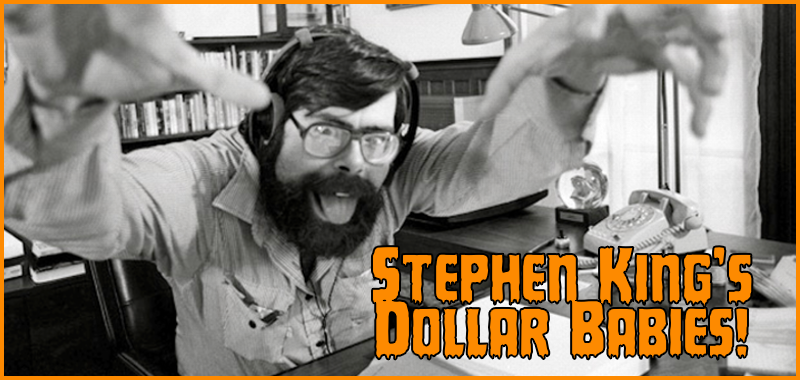
So it was with this understanding of being utterly devoted to creating works of art – combined with the fact that he didn’t really need any more money – that King began allowing aspiring film makers the right to film any of his short stories… for one dollar. He labeled these projects his “Dollar Babies“.
By the late 1970s King had amassed a large collection of short stories, and after the successes of his full length novels Carrie, ‘Salem’s Lot, and The Shining, he started receiving correspondence from college-aged film makers hoping to adapt a piece of his work. As King tells it:
Around 1977 or so, when I started having some popular success, I saw a way to give back a little of the joy the movies had given me. ‘77 was the year young film makers – college students, for the most part – started writing me about the stories I’d published, wanting to make short films out of them. Over the objections of my accountant, who saw all sorts of possible legal problems, I established a policy which still holds today. I will grant any student filmmaker the right to make a movie out of any short story I have written, so long as the film rights are still mine to assign. I ask them to sign a paper promising that no resulting film will be exhibited commercially without approval, and that they send me a videotape of the finished work. For this one-time right I ask a dollar. I have made the dollar-deal, as I call it, over my accountant’s moans and head-clutching protests sixteen or seventeen times as of this writing [1996].”
So with those simple rules in place, students and ambitious directors were allowed to have at it. The professionalism on these projects covered both ends of the spectrum, from hundred-dollar cheapies shot on VHS, to big-budgeted badboys like the adaptation ofUmney’s Last Case, which was shot on 35mm film for over $60,000.
Some of these little labors of love would end up being launching pads for soon-to-be award winning directors. So let’s look at a few of the firstDollar Babiesever produced, and the teams behind them.
The Boogeyman is the first Dollar Baby to be produced. Released in 1982 (based on a story written by King in 1973), it was directed by Jeffrey C. Schiro who would later get into TV, directing an episode of Tales from the Darkside. It had a budget of a whopping $20,000! In 1982, that was practically a million bucks. While Schiro and his crew didn’t go on to do much more after this little flick, the seeds were planted for an exciting new venture with endless possibilities.
This 30 minute short came out in 1983 and was based on King’s 1977 short story, Children of the Corn. This is where things get interesting: in the beginning of King’s career, there was really only interest from major movie studios in his full length novels, which is why he allowed budding auteurs to adapt his shorter works for only a dollar. While not necessarily a loophole, it did allow a fortunate few to be the first to adapt what would later become major motion pictures. Disciples of the Crow was the first instance of this, but it wouldn’t be the last.
Perhaps the most prominent and significant of all the entries, The Woman in the Room was not only Frank Darabont’s first film but also technically the first Dollar Baby. A 20-year-old Darabont, who wasn’t even involved in the movie industry at the time, loved the story so much that he wrote King a letter asking if he could make a short film of it. King, keen on conceptualizing a way to allow this put into action the Dollar Babies. It took Darabont over 3 years and $35,000 to complete the film, making his entry third on the list – but he was the first one to approach King with the idea back in 1980. King went on to say it was, “Clearly the best of the short films made from my stuff.” So good, in fact, that Darabont and his crew entered it for Oscar consideration in theshort film category. It even ended up being purchased (along with The Boogeyman and Disciples of the Crow) for release on home video. It would be the beginning of a long and successful career for Darabont, who would end up adapting several more of King’s works – The Mist, The Green Mile – and would eventually win the Oscar for Best Picture (as well as pretty much every other category) for The Shawshank Redemption – which of course, was based on a short story by Stephen King.
Last on the list, we have the whole reason I wrote this piece: The Lawnmower Man. I was surfin’ the net as kids are wont to do these days, when I fell down one of those rabbit holes – the deep and endless kind where one click leads to another click, leads to another, and another; from Wikipedia, to Youtube, and back again. Link to link to link. I’d somehow found myself watching what I thought was some cheapo home movie on Youtube simply entitled The Lawnmower Man. And I wasn’t entirely wrong: it is a cheapo homemade movie, and it is entitled The Lawnmower Man. But what I didn’t realize until seeing the opening credits was that it was indeed based on Stephen King’s short story of the same name.
Most notable is the fact that this short film is more faithful to its source material than1992’s big-budgeted takeon the story, which bears absolutely no resemblance to King’s work other than in name. Pretty impressive: some anonymous students with $5,000 did a better job of adapting a Stephen King story than Hollywood could with 10 million smackers.
And that’s the beauty of the crossroads where determination, creativity, passion and respect intersect. King is an artist – once a very struggling artist – and he knows what it’s like to have that fire burning so badly in your belly; nothing can snuff it out, but being allowed to create your art can at least temper the flames for the time being.
—————————————-
*Whenever genius strikes me – whether I’m in the shower, trying to fall asleep, or drinking an Olympic-size swimming pool amount of beer (almost always that last one) – the first thing I do is run to Google. I immediately punch in whatever article idea I have to make sure of two things:
That it’s an original idea. And,
That if it has been done before, either A. Enough time has passed for my article to be fresh, or B. My article introduces some different or new information than the previous articles.
In this Internet Age when everything is a rehash of a rehash, it’s important to me to do my best to not add anymore overdone, hacky detritus to the pile of listicles, burying worthwhile reading deep underneath. Sometimes I write an entirely original piece (like my article on the name Francis in 80s movies); sometimes I write on a familiar topic, like Jason Voorhees. Either way, I try my best to make it my own – and it’s always a challenge I welcome.
NOW, all that being said, when I wanted to write this piece on Stephen King and his “Dollar Baby” concept, I did like I always do and searched Google. And damn it all, wouldn’t you know it that Den of Geek just wrote a piece on this same topic not even 2 months ago! Alas, that’s the way things go when you’re trying to generate new material in this fast-paced web-based world. I decided to proceed anyway because after reading their take, I thought I definitely had more to add. I’m an admittedly long-winded, overly-explanatory writer, and to me this is a definite strong point; I make sure to cover every facet, explain every detail, and inject as much personality in my articles as I can because I want to convey to the reader that I not only know what I’m talking about, but that I actually enjoy the subject I’m writing about. I don’t want it to read like I’m some paid shill who got an email full of factoids to investigate from my boss. Because I didn’t, I’m not being paid, and I don’t have a boss. It’s all me, baby.
Anyway, I included this disclaimer because, I don’t know…I’d feel grimy otherwise. I still encourage you to read their piece, too! And then tell me mine was better, naturally.
Werewolves have been a horror film staple since Lon Chaney (that’s the junior Chaney) donned the faux fur in The Wolf Man way back in 1941. Since then, movies have tried to present lycanthropes in a variety of differing ways, doing their best to expand upon the lore and offer a little variety to the standard “man bitten by wolf seeks out gypsy who explains the changes he’s been seeing in his body”. Whether it’s as simple as a high school geek who suddenly becomes popular due to his fur-suit (Teen Wolf) or high brow werewolf-as-metaphor (Mike Nichols’ Wolf), the genre has seen it all. Sometimes it’s fun, creative and pulled off successfully, as in the case of American Werewolf in London. And other times, well, it’s Howling IV.
Late Phases falls somewhere in the middle of those two, though it definitely teeters more towards the positive end of the spectrum. Granted, I’m not a werewolf or vampire fan (I can’t explain it, just never been a fan), but of the movies I’ve seen about people turning into wolves? This’n ain’t so bad.
The movie finds blinded ‘Nam vet (Nick Damici) and his dog (who provides more companionship than guidance) being dropped off in an old folks community, essentially deserted by his son. However, Damici is a grizzled, tough ol’ grump who would rather spit “good riddance” than give off any vibes of abandonment.
The film jumps into action almost immediately, with Damici encountering the fanged antagonist within the first 10 minutes. It soon becomes apparent – from the clueless residents to the typical “let us handle it, sir” behavior from the local law enforcement – that Damici is on his own, and stopping the beast is entirely up to him.
The movie borrows heavily from Silver Bullet, the Stephen King novel-turned-film about a wheelchair-bound boy who thinks the preacher at his local church just might be a werewolf. Late Phases has its own preacher who just may be a werewolf, too. This movie, however, is sorely lacking the presence of a totally batshit Gary Busey.
Of course, it wouldn’t be a werewolf movie without a transformation scene, and Late Phases has a beautifully executed one, with creature effects courtesy of Robert Kurtzman himself. The way it’s shot, it seems to be the centerpiece of the film – and I can understand why.
Lastly, it wouldn’t be a film review without just a little criticism. Nick Damici. Oh Nick, Nick, Nick. I’ve seen Mr. Damici in four films now (Mulberry Street, Stake Land, We Are What We Are, and Late Phases), and I can tell you this: no one is a bigger fan of Nick Damici’s acting than Nick Damici himself. He’s not bad by any means. In fact, he’s better than that one-note hack Leonardo DiCaprio (and look how famous that a-hole is.) I just feel like everything I’ve seen Damici do has ‘acting class’ stamped all over it. Perhaps it comes from his recent career of writing his own lines (as was the case with Mulberry Street, Stake Land, andWe Are What We Are) that makes it seem like he thinks everything he’s saying is the coolest, most profound, most hilariously badass line ever said. And while he didn’t write his own dialogue for this movie, there are still some very hammy – borderline sleazy, even – undertones to his acting and line delivery.
And despite the passable age make-up he wears throughout the film, I just wish the 50 year old Damici had been dropped off in a retirement community that housed people his own age, instead of the 70 and 80 year olds that inhabit it.
Overall, a fun entry in the full moon genre and worth a watch for sure.
I’ve seen The Running Man (not to be confused with Marathon Man, which itself is not to be confused with The Marrying Man) several times over last couple decades, almost invariably on some basic TV station, edited for noontime viewing; always in scattered, unorganized chunks. And I’ve never not liked it; if someone asked for an opinion on it, I’d probably say, “Oh yeah, that’s a cool movie”, without giving it much thought. Not much thought, that is, until I watched it again today. If someone were to ask me what I thought of that movie now, I’d say, “Oh shit. Have you seen it?? You totally gotta see it!” And thankfully you can – it’s currently streaming on Netflix.
Like any masterpiece, it not only stands the test of time, but actually gets better with age, and offers new little, trivial tidbits to appreciate with each subsequent viewing. I promise I’m not saying any of this to be ironic or hip; I say these things with an earnest regard. The movie apparently received a lukewarm reception upon its initial release, but I’m here to say: I think this movie is totally solid, enjoyable, and possibly one of Schwarzenegger’s best. Not to mention this movie was the direct inspiration behind the show American Gladiators – and if that’s not reason enough to get you to watch it, well then, we’re done here.
Written by Steven E. de Souza (48 Hrs., Commando, Die Hard) and loosely based on a story by Stephen King, the movie is set in the distant future (I say ‘distant’ because at the time it was filmed [1987] the year 2017 was quite a long time away), and it follows a police officer (Schwarzenegger) who is framed for murder and is forced to participate in a new reality game show that’s apparently one of the most popular forms of entertainment. On this gameshow, convicts are offered a chance at freedom if they can make it through a successive series of heavily armed baddies known as “stalkers”. If the cons survive all the stalkers and get to the end, they can go free.
I’m not sure if it’s just a weird coincidence, but the film shares several tiny parallels with Schwarz’s other films — and not in the broad ‘strong guy fighting bad guys’ general way, but in more specific ways: he wrestles with a woman while she watches an exercise program on TV (Total Recall); he’s implanted with a tracking device while trying to break free from the gurney he’s strapped down to (Total Recall); he tries to escape capture by running down a tarmac (Commando). They are little things, but seeing them evokes flashes of his other movies. I’m sure I could spot more if I watch it again.
So that’s the basic gist of the film, but I wanna point out three things that I think make the movie so enjoyable.
THE CAST
Yaphet Kotto, Richard Dawson, Kurt Fuller, and Jesse Ventura in a Conan O’Brien-style wig! Not to mention María Conchita Alonso, Mick Fleetwood (!), Dweezil Zappa (!!), and Sven Thorsen. Plus Lynne Marie Stewart (Miss Yvonne) and Lin Shaye! Familiar faces abound, and are all wonderfully cast – from Dawson as the smug and charming TV show host (real stretch), down to the Ventura as the conflicted, glory-day embracing macho man. And speaking of cast, let’s look at the baddies the runners have to face:
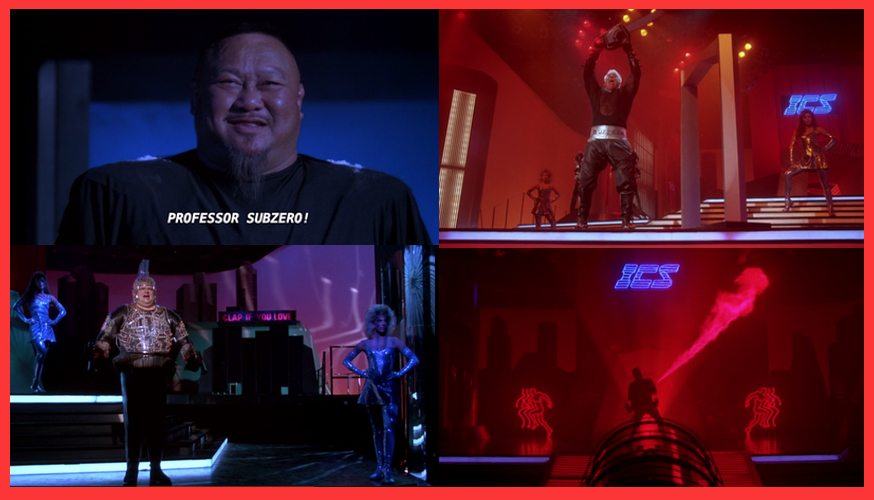
Professor Subzero, Buzzsaw, Dynamo, and Fireball. Does it get any cooler? Buzzsaw rides around on a motocycle while swinging various chainsaws around! And look how mysterious and badass Fireball looks. Plus, if you didn’t notice, Professor Subzero is played by ex-wrestler Professor Tanaka who played the butler in another great Schwarz flick, Last Action Hero. Dynamo is a bit of an oddball — played by real life opera singer Erland Van Lidth de Jeude (probably most well known for his scene as soft-spoken skinhead Grossberger in Stir Crazy), Dynamo isalso an operatic killer who uses electricity to off the runners. And Fireball! Played by the ultimate bad motherfucker, ex-footballer and blaxploitation mainstay, Jim Brown! A mustache-less Jim Brown, at that.
SET DESIGN
Look at any movie from the 70s or 80s that is supposed to be set in the future, and you get either one of two looks: a post-apocalyptic desert-like landscape where people wear bones as a fashion statement, or a vast cityscape full of big angular buildings that are shrouded in smog and neon. I love both of these approaches, but they always seem to be mutually exclusive. However, The Running Man combines the two with great effect! The stalkers, while still being futuristic in their design, are still just rough around the edges enough to evoke thoughts of Mad Max. And the layout of the killing floor is at times both metallic and galactic, but also somehow sparse and dusty. Additionally, the music was provided by Harold Faltermeyer, famous for his bouncing synth scores in movies like Beverly Hills Cop, Fletch, Top Gun, and Tango & Cash – and it compliments the visuals perfectly.
THE ONE-LINERS
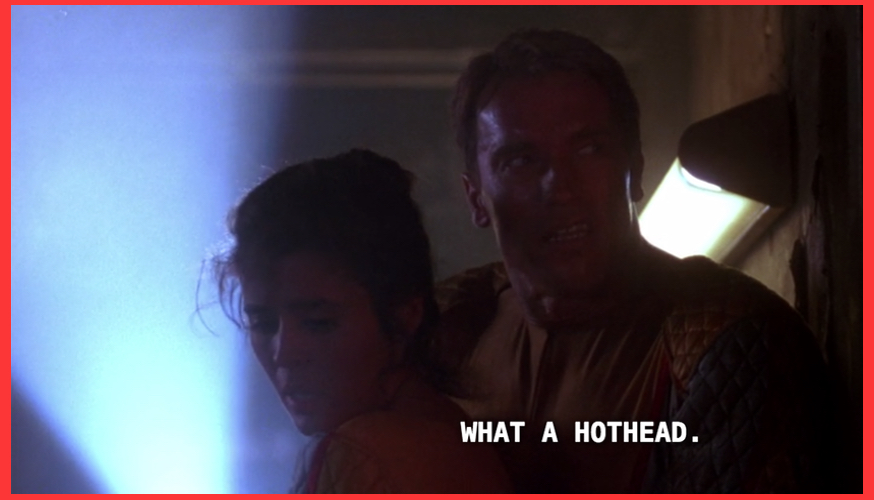
Arnold Schwarzenegger is no stranger to delivering a face-slapping punny one-liner just seconds prior to snuffing a bad guy. But this movie is full of ‘em. He even lets the ladies have a little taste:
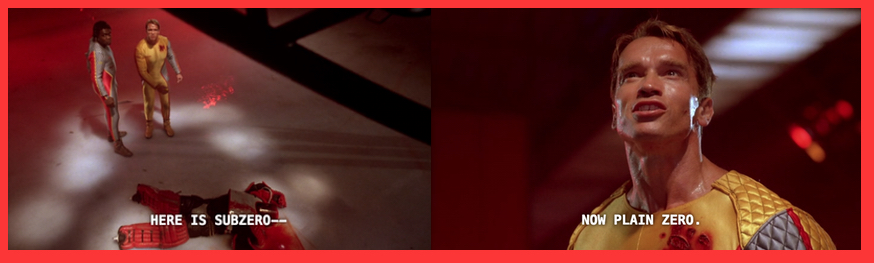
At one point, he even delivers two puns after killing Fireball, as if one just wasn’t enough.
Hell, he even says shit that doesn’t make sense but still feels as if he’s trying to be punny:
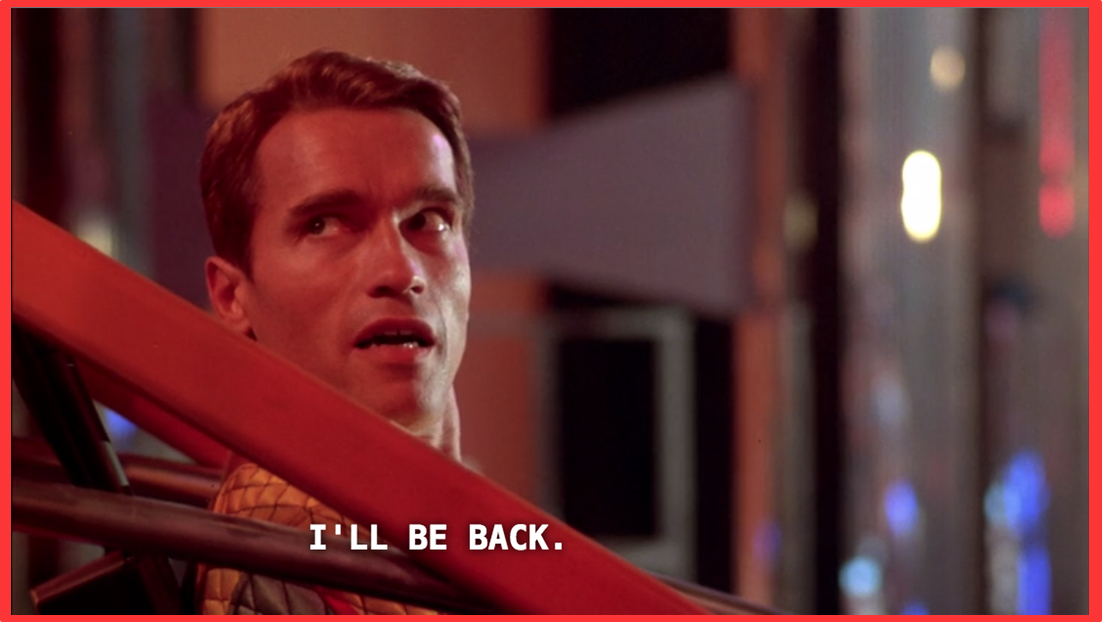
And it wouldn’t feel complete without the inclusion of this bad boy:
Pure Schwarzenegger.
Well there you have it, friends. If you like films like Logan’s Run, Mad Max, Death Race 2000, hell even The Hunger Games, you’ll probably dig this flick. I highly encourage you to check out The Running Man if you haven’t yet – and I also suggest giving it another look if it’s a been awhile since you last watched it!










 Camera Viscera