Category Archives: Reviews

“Creep” (2015) MOVIE REVIEW

Finally, Jason Blum has produced a movie I like! Okay, okay: I like a few of his movies. And sure, it’s still a found footage deal, but at least it drops all the overwrought ‘paranormal’ bullstuff.
4

By design, ‘found footage’ movies should be stripped down and straight-forward, and a very easy thing to pull off. Camera, people, conflict. Simple! Yet time and time again, producers and directors fudge it up beyond all logic. Unexplained jumps in time, having the camera always pointed in the right spot at the right time (every time!), and perhaps most forehead-smacking of all: music! And I’m not talking about music being played on a radio in the movie, I’m talking about interstitial horn stabs and ominous strings throughout, because how are you going to know the movie is scary unless there’s a big crash of music when something scary happens? Obviously it’s because they’ve created a shoddy, empty product and need to attach all the bells and whistles to distract you the viewer from noticing just how unscary (or uninteresting) their movie is. Thankfully, Creep avoids all of these distractions.

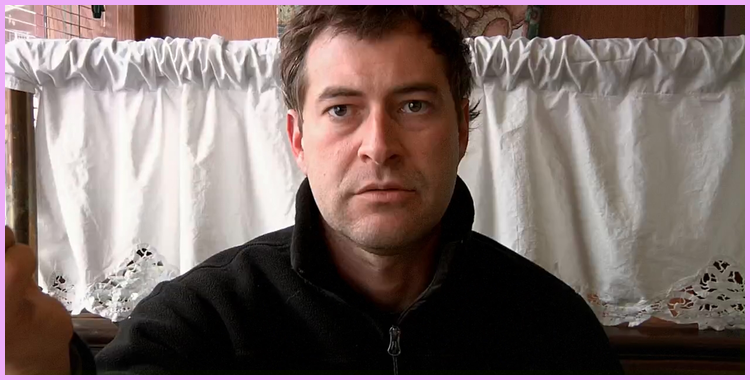
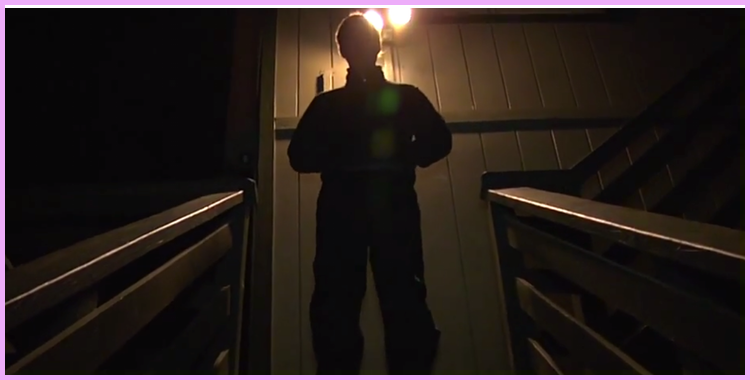
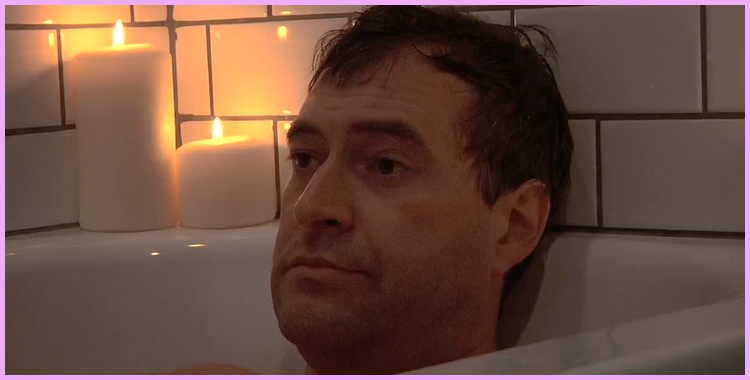
The movie sees Aaron (Patrick Brice, who also wrote and directed the movie), a freelance videographer, answering an online ad where the only information is essentially, “Looking for someone to film for 8 hours, easy work, $1000.” He soon finds himself at a remote cabin with a complete weirdo (er, I mean, creep), Josef, (played by Mark Duplass who also helped write the movie) who claims he’s dying of cancer and is hoping to film a memorial video for his unborn son, à la My Life.  At first, Josef seems like a clingy, desperate, lonely guy — but soon things go south. And that’s all I’m gonna say.
3

Now, I’d seen the teaser prior to watching the movie, and I gotta say: I wasn’t into it. And when I started the movie, I was still on the fence. But slowly the movie started to take effect and I found myself deeply immersed. One of the great things about Creep is constant surprises. You never know where it’s going or what’s going to happen. And after finishing the film, I really appreciated the aforementioned vague teaser I’d seen because it didn’t spoil anything. That’s something I miss about the extinct respectful relationship between trailers and movies (and moreso now, viewers and movies): being shocked and surprised — and really enjoying the product, as a result — because it hadn’t been spoiled beforehand. It kept me guessing until the very end, and I can’t say that about a lot of movies.

As I’d mentioned earlier, this movie finally gets ‘found footage’ right, if you’ll even consider it ‘found footage’ (anything with a shaky cam and people addressing the audience directly pretty much constitutes ‘found footage’, right?) No music, only two leads, and (thankfully) no ghosts or paranormal stuff. Since Duplass is the king of “mumblecore” and has already filmed a similar handheld semi-horror flick (mumblegore? Mumblehorr?) Baghead, this movie is perfect for him, and he obviously knows how to handle the role. What I wasn’t expecting, however, is just how truly terrifying Duplass could be.

When I started the movie, there were a few places where I thought “Why doesn’t Aaron just leave?” or “There’s no way Josef would act that way.” But as I kept watching, I started to realize that I knew people like Josef, and I’ve found myself in the Aaron role many times. You’re in a situation you don’t want to be in, but you feel bad for the person you’re with, so you willingly ignore logic just to be a good person, an empathetic person. Even when there are big, red warning signs saying “run, now!”, you go along with it just so you don’t inconvenience that person.
2

By the end it had me thinking, “just how many seemingly nice and normal people do I encounter everyday who are completely and utterly unhinged?” It kinda freaked me out. That fact combined with all the handheld camera stuff also got me to thinking about Ricardo López, the dude who stalked Björk. He recorded a lot of home video tapes — essentially video love letters — for the singer. But in the videos (which are incredibly disturbing [and available on Youtube!]), you see López start out as this lonely, desperate, sad guy…and watch him devolve into this dangerous, blood-thirsty lunatic. It’s horrifying. And realizing that, yeah, anyone can come unglued if the paper ain’t sticky enough? That might be scarier than anything else.

Lastly, this is apparently the first in a trilogy of Creep movies. If they end up being half as scary as Creep was, I’ll be a happy camper.

Creep is available on VOD and Netflix Streaming, so watch it now! But leave the lights on!

creep

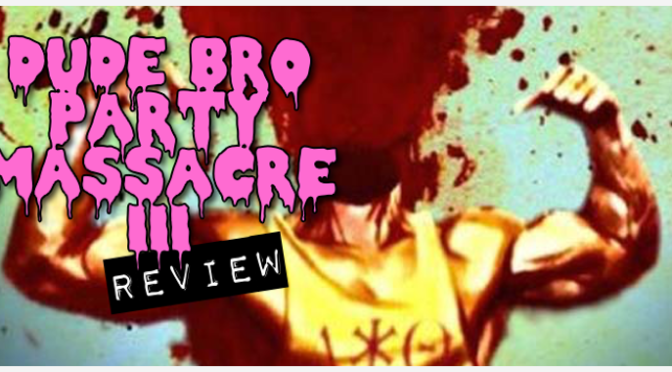
“Dude Bro Party Massacre III” (2015) REVIEW

There is so much — and yet, somehow, so little — to say about Dude Bro Party Massacre III, so I’ll offer up both a short and lengthy review.

Short review: the movie, sadly, is a mess – both tonally and stylistically – and that’s a real bummer because the trailer looked promising, and my hopes were high. Whether intentional or not, the movie ended up being confusing, distracting, and (unfortunately) just plain unfunny. I kept checking to see how much longer until it was over, and that’s not a great reaction to have when watching a movie.

There, that’s the succinct review and I already feel like a jerk. If you’re interested in the details, read on.

1

Perhaps the biggest sign that Dude Bro Party Massacre III was doomed from the start is the fact that it was made by the people at 5-Second Films. Now, I have nothing against 5-Seconds Films; I love their stuff. In fact, if you aren’t familiar with their work, do yourself a favor and go check them out right now — their videos are hilarious, bizarre, and creative (this one is my personal fave of their shorts.) However, the micro format is clearly their strong suit, and attempting to stretch that out into a full length film unfortunately just doesn’t work. It makes this 90 minute movie feel like you’re actually watching 1,080 of their shorts back to back; a very exhausting feeling. Another unfortunate side-effect of cramming a joke in every 5 seconds is that almost of all of them fall painfully flat.

The central plot is fairly straightforward: a college kid joins a frat that his dead brother was once a member of in order to solve/avenge said dead brother’s mysterious murder. There is a bizarre (and completely unnecessary) subplot involving a couple of bumbling cops (and a cult leader? And oranges?), but their involvement in the basic story is too confusing to explain. Interstitial bits and pieces of bad tracking, blunt cuts, and fake commercials are thrown in the mix, making even the most basic storyline that much more impossible to follow.

That’s another issue I have with the movie: it tries to cash in on the current very popular trend of making something look like it was shot on VHS tape. Films, Youtube videos, TV shows — they all want to achieve this ‘look’ without adhering to the restrictions that would actually result in an analog recording being shot on magnetic tape. (One of the greatest offenders of this rule is V/H/S, a horror anthology which inexplicably dedicates an entire segment to computer video chats [a digital medium], not to mention several other anachronisms such as a pair of glasses outfitted with a hidden camera [yet another digital medium.]) Let’s put it this way: if the movie Super 8 featured a kid lugging one of these RCA shoulder-mounted consumer camcorders around instead, people would cry foul. Dude Bro Party Massacre III commits similar bothersome acts.

3

Animated words pop up onscreen, goofy sound effects occur, weird out of place transitions and obvious green screen effects abound. None of it makes sense in the context of things. The recently released Kung Fury — another VHS-style throwback — also commits these same acts, but the difference is that Kung Fury so obviously takes place within its own imaginary landscape, one that feels more videogame than actual movie, that it’s pretty much able to do whatever it wants and get away with it. DBPM3 wants you to feel like you’re watching an 80s horror movie taped off TV (it even tells you so with an opening crawl), but yet it doesn’t want to play by its own rules. (It also helped that Kung Fury was only 30 minutes long.)

Lastly, one final impediment: contradictory as it may sound, Dude Bro includes far too many references which end up hurting it doubly. The movie is loaded with 80s cliches, silly commercials, cheesy gore (the best part of the movie, actually) vapid characters, etc. DBPM3 is its own worst enemy because it fails to find a balance. Had it been played perhaps a little more straight-forward (and cut out about 2/3 of the jokes), it might have played a little better.

There is a crossroads — a junction where satire, homage, parody, and pastiche all intersect — that, if handled carelessly, can create confusion, blur the point, and distract the viewer. Ultimately, that’s what happens in Dude Bro Party Massacre III.

There are a few things that almost work — a montage where the bros clean up a dirty frat house to a dorky 80s song (ala Revenge of the Nerds) and a brief scene where a guy (Greg Sestero!) gets freaked out by several gardening implements in a tool shed (shot in a very Raimi way) — but those moments are quickly buried as the film eagerly jumps to the next weird joke/setting/character/edit/effect.

It has a great premise, a great title, and I do love the worn out videotape look, but there’s just too much going on. If you want a film that does a good job of spoofing a specific era, look no further than Wet Hot American Summer (a film I feel greatly inspired this one.) Or hell, just rent an actual shot-on-video horror movie like Woodchipper Massacre, Cannibal Campout, or Video Violence. Those movies are just as cheesy and silly as DBPM3, but are far less likely to induce seizures. If a 90-minute Tim and Eric sketch on speed is what you’re looking for, you will love this film. Otherwise, you may find yourself feeling a bit let down.

“Spring” (2014) & “Maggie” (2015) REVIEWS

I wasn’t going to review these movies together for any deep reason — I simply watched them back-to-back and thought I’d kill two birds with one review. After all, these were two very different films — tonally and stylistically — and I really liked one and kinda hated the other one. Pretty different flicks altogether.

But the more I thought about it, the more I drew parallels between the two films: both were fairly under-the-radar VOD films about having to accept the fate bestowed upon a loved one while helplessly watching them turn into some awful thing. So maybe reviewing them together does make sense in some loose way.

I knew very little about each film prior to watching them, but I’d seen nothing but praise and warmth for both films circulating online. I’d watched a trailer for Maggie and knew Arnold Schwarzenegger was putting in a dramatic performance as a farmer who watches his young daughter slowly succumb to a zombie bite. As for Spring, I’d only seen its poster and the head-scratching Rastafarian color scheme. I also had a friend who’d seen Spring and said he enjoyed it, but that the writing was “very college”, and it was a bit sappy. And I knew from reading a brief synopsis on iTunes that a guy goes on a roadtrip to Italy, falls in love, blah blah blah. At this point, I was totally on board for Maggie and couldn’t care less about Spring.

Oh, how wrong I ended up being.

I watched Maggie first, as I was more interested in it than Spring. It starts out promising, if not completely trite: muted color palette, desolate fields with arbitrary fires burning, governmental warnings being delivered in fuzzy bursts through an old truck radio as it ambles down a lone, vacant highway — the apocalypse, baby!

Maggie

But boy it loses steam, and quick. It took me three tries before I was able to make it all the way through this 95 minute movie. It is rough. It’s fairly void of any dialogue, and the lines we are gifted are so brutally hackneyed. An incredibly miscast Arnold Schwarzenegger (playing a painfully earnest farmer) gives his daughter the old “you remind me so much of your mother” speech while he works on his truck; they laugh, they bond; it’s technically a ‘scene’. And when the film isn’t being incredibly cliche, it’s being incredibly oversentimental. Laughably, shockingly oversentimental. I almost want to spoil the ending because of how downright ridiculously saccharin it is, but where’s the fun in that? And then there are several ‘slo-mo traipsing through a field’-style shots from the Terrence Malick handbook which just end up feeling more like an anti-depressant commercial. There are so many of these shots, too many, that it feels as though they were included simply to pad out the runtime versus any real artistic or stylistic reasons. Also, when is this movie set? Their clothes, their house — they look like they’re from the 1800s. Yet everyone and everything else — Maggie’s teenaged friends, the local police — are modern. I mean, sure, I get it, “they’re farmers! Haha! Farmers always look that way, right?” It just furthers the uninspired laziness of the film. Also, this film apparently cost $8M to make when all was said and done, yet nothing happens at all. No explosions, no elaborate choreography or big set pieces. There is some (and I stress some) zombie make-up and very little CGI. Other than that, it’s all handheld camerawork on a farm. That’s it. Where ever that money went, it did not end up on the screen.

And for the people commending Schwarzenegger’s dramatic acting, c’mon, give me a break. I got more chills from the scene in Terminator 2 when he gives the thumbs up as he’s being lowered into molten metal than I did from his whole performance in Maggie. And I know that sounds funny and snarky, but I’m being serious. I’ve seen Arnold play the ill-fated lead quite effectively before, but that is not the case with this film.

So after the incredibly disappointing Maggie I was fairly hesitant to watch a film I had no real interest in watching to begin with. But I turned on Spring and holy shit I was blown away! Beautiful and competent cinematography, gorgeous locations, believable and engaging leads, effective and well done practical and CGI effects. Not to mention a smart script and original premise. I really, really enjoyed it.

Spring-Alley

I immediately got a Before Sunrise meets The Thing type vibe from it, and upon doing a little research have since found people calling it “Richard Linklater meets H.P. Lovecraft” — so my initial reaction was pretty on point. I won’t spoil it, but basically a burnt out American runs away to Italy where he meets and falls for a girl with a pretty heavy duty secret.

One of the many things I enjoyed about the film was that it didn’t let me down. Maybe that sounds silly and obvious to say, “I liked it because it was good!”, but horror movies these days so often find a way to ruin all the momentum they’d been building by tacking on a copout of an ending, or they blow it by throwing some unnecessary curveball in the middle that immediately evaporates the movie’s credibility. Not so with Spring. That’s not to say I wasn’t waiting for it at every turn, with every advancement; I was. But no, it keep moving along, sensibly and fluidly. And I just kept liking what was happening more and more. It’s great.

There is one, single scene early on which features a rapey dudebro type that feels forced. It only stands out because everything else is done so flawlessly. But thankfully that single scene is quite fleeting — seconds long, really — so it doesn’t distract too much.

At just shy of 2 hours, Spring is a long horror-ish flick, but it never feels long — and that’s a sign of skillful filmmaking.

Spring and Maggie may be similar films, but it’s the reasons they’re dissimilar that make all the difference.

“We Are Still Here” (2015) REVIEW

There’s a strange trend I’ve noticed lately in independent horror: directors are seemingly desperate to prove to us, the audience, that they are worthy horror directors simply because they have a vast knowledge of horror movies from the past. And how do they prove that they know their horror history? Well, they just take a bunch of familiar fan favorite horror flicks, mash them up, and turn them in as a supposed new product. Sometimes it works, sometimes it doesn’t. Does this actually make for a worthy horror director? Does merely stoking the embers of nostalgia equal competent, compelling storytelling? Who knows, man. Why does Quentin Tarantino get to blatantly steal his ideas and characters from 70s exploitation films and win Oscars for it? Why does Led Zeppelin get to steal every riff they never wrote and still be hoisted up to an untouchable, God-like status? I don’t know, man. I just don’t know.

Now sure, there will be repeated tropes that I bet are near-impossible to avoid. Horror films have been around for 120 years; there are gonna be a lot of commonalities among films. But the modern thing I’m talking about is more than that. Adam Wingard’s The Guest (which I like) is a mash-up he describes as “The Terminator meets Halloween“, after he supposedly watched them back to back. Starry Eyes (which I loathe) is just Rosemary’s Baby meets The Fly (1986), until the last few minutes when it unfortunately dissolves into standard slasher stuff. Irish ghost flick The Canal (which I love) covers a whole range of movies, from Jacob’s Ladder to Pet Sematary. Sometimes the references are more subtle and play out as homage. The artistic influences of movies like It Follows or The Babadook reek of John Carpenter and Roman Polanski, respectively, but they don’t feel like they were simply pieced together from old classics; they took familiar sensations and made them new again. Like I said, sometimes it works and sometimes it doesn’t.

The point of all of this is We Are Still Here, the haunted house/ghost/occult/possession/revenge flick from director Ted Geoghegan is such a mish-mash of references and themes that it fails to gain any footing and therefore elicits few scares.

ghostSet during an ambiguous decade, presumably the 1970s, a middle-aged couple (played by Barbara Crampton and Andrew Sensenig) decide the best way to cope with the recent death of their son is to move out of the city and head for a house in the sticks. Almost immediately after moving in, Crampton tells her husband that she “feels” their sons presence in the new home. Shortly after that, an electrician is attacked by a mysterious entity in their basement. Soon after that, they receive a strange visit from their nearest neighbors (which is apparently pretty far, considering how remote this new home is), who inform the couple of a tragic history surrounding their new woodland residence: it used to be a funeral parlor at the turn of the century, run by the Dagmar family. Turns out, the family was also selling the bodies and doing other types of desecratory things that caused an angry mob to dole out a bit of street justice and murder them all. After telling this story, the neighbors abruptly leave, and the house goes back to creaking and thudding.

Crampton and Sensenig invite their hippy-dippy spiritualist friends, played by Larry Fessenden and Lisa Marie, out for the weekend to help them get to the bottom of these disturbances. Soon after this, things go from bad to worse. And before you know it the credits are rolling. There’s stuff I’m not telling you as to not spoil some of the twists and turns, but that’s pretty much it.

So what works and what doesn’t? Well there are some promising creepouts in the beginning of the film. I won’t give away anything, but within the first 10 minutes of the movie I was totally onboard, ready to have the bejesus scared out of me. But as the movie progresses, the scares become less scary and the plot less coherent. By the time the final act rolls around, it feels like they were trying to play catch up with all the time they squandered during the first two thirds of the movie.

Director Ted Geoghegan – like Wingard before him – openly admits the influences of his film, going so far as to name the evil characters after one of the actresses from Lucio Fulci’s classic supernatural Video Nasty, The House by the Cemetery. But there are other influences to be found: Evil Dead, The Exorcist, PoltergeistChildren of the CornThe Shining, hell even Straw Dogs! But references do not a good horror movie make.

I love Barbara Crampton. Love. Besides the fact that she’s a genre staple and an always welcome face, she’s actually a really good horror actress. In fact, I’d go as far as to say she carries this film. Everyone else is pretty wooden, with exception for contemporary iconic horror figure Larry Fessenden, who does a better 70s-era Jack Nicholson in this movie than Nicholson could do himself — the hair, the arched eyebrows, the sloven-yet-charming air about him — Fessenden is the warm, likable comedic relief to Crampton’s distant and numb mother-in-mourning. I also love that the protagonists of the film are middle-aged parents. It’s a small detail, but one that actually makes a world of difference. And let me say one last time how much I love Barbara Crampton.

While this review may come across as generally negative, I assure you it’s not. The feeling I was left with after watching We Are Still Here was actually one of indifference. Feeling like I’d seen it before and I didn’t care. The mashing up of every ghost/witch/haunting trope, combined with the overwhelming praise I’ve seen (mainly from horror sites with a large following to maintain and reputation to uphold, which makes me question the earnestness of their reviews), left me even more confused and unenthused.

Independent horror has always been vital to the scene, but especially nowadays when the only horror that seems to be getting wide-releases are sequels and remakes. Independent horror should be an untamed landscape, a fertile ground to generate new, weird ideas. Films like The Texas Chain Saw Massacre, Shivers, Repulsion, and Sisters are all great examples of independent horror from the past, from directors who had clear, original visions. Unfortunately, We Are Still Here chooses not to be part of that camp, and instead falls into familiar beats and patterns, ones I have no doubt we could see on the big screen in Insidious: Chapter 3, Ouija, Paranormal Activity 5, Rings, Poltergiest (2015), et al.

In a time when horror fans seemingly have only two options to get their fix, forced to decide between referential, homagey shoulder-shruggers and borderline-offensive, slapdash remakes and reboots, I’ll gladly choose the former. But only because it’s the lesser of the two evils.

wsh

“The Addiction”

add3

In honor of the Iranian black and white vampire flick A Girl Who Walks Home Alone at Night being released on Netflix Streaming this week, I thought I’d talk about another contemporary monochromatic vampire flick with a female bloodsucker as the lead – The Addiction.

Directed by gritty and unflinching crime/exploitation maestro Abel Ferrara, The Addicition doesn’t seem to get mentioned much or at all in horror circles, but it’s as interesting and relevant now as it was in 1995 when it was first released.

Social commentary in horror films is nothing new – in fact, it usually lends itself in creating a longstanding and enduring piece of cinema; a celluloid sign of the times.  There was the consumerism of the 70s in Dawn of the Dead; distrust of strangers and the fear of Cold War in 1982’s The Thing; and there’s the heroin boom of the 90s in The Addiction. There was a reason that decade begat the term “heroin chic“: never had it been purer and cheaper than it was in the early 90s, and never was it more deadly.

add1

Drugs are a common theme in Ferrara’s films – as well as his life. The star of his film Ms. 45 and writer of Bad Lieutenant, Zoë Tamerlis Lund, died of a heroin overdose just a few years after The Addiction was released. There is perhaps no better director to handle the real life horror of drug abuse – the allegory of the undead in constant search of fulfillment – than Ferrara himself.

The subject matter is delivered in the most collegiate of ways, aided by the fact that the story follows a college student. Shot in black and white, the films feels at times almost like a student film or a documentary. The dialogue is verbose and poetic, with constant references to philosophers like Kierkegaard, Goethe, and Nietzsche. It’s about as Shakespearean of a vampire flick as you’ll ever come across.

Though completely different tonally, there are similarities between The Addiction and A Girl Walks Home Alone at Night, more than just their desaturated look and female leads. Girl also deals with a contemporary issue: the Middle East’s view of women and their lack of rights, their subservient role. Girl jams a big middle finger in the face of all that and wants the audience to do the same, much like Ferrara was trying to desperately grab the viewers by the shoulders and shake them, saying, “Look at how fucked up this life is.”

add2

Both solid films worth a watch, no doubt. Just don’t want The Addiction to go unnoticed when it deserves to be viewed just as much and deserves just as much praise as A Girl Who Walks Home Alone at Night. So go watch ’em both!

“It Follows” (2015) REVIEW

When information about It Follows started traveling down the internet pipeline, and after I’d watched the trailer, two words immediately popped into my head: “Black Hole“.

panel2

From 1995 to 2005, comic artist Charles Burns released a limited run story called Black Hole. Set in the dreary, overcast Pacific Northwest during the mid-70s, Black Hole follows a group of suburban teenagers with nothing better to do than wander the woods, smoke dope, go to the ocean, and screw. It’s well known between the two leads in the story (as well as every other character) that a mysterious sexually transmitted disease (“The Bug”) is being spread among the teens – one that affects each person differently, but still turns them into some sort of freak or mutant. And just like life, some get it worse than others.

Besides being gorgeously illustrated (I hate to use hyper-bowl on ya, but every damn page is absolutely jaw-dropping), the thing that really sells Black Hole is how nauseatingly real and relatable it was – afterall, we all were, at some point, teenagers – and we all had to deal with those awful, shitty teenage feelings. First loves, the pressure of not fitting in, the uncertainty of the future. I’m breaking out in a sweat just typing about it now.

But Burns managed to take this story of teens-turned-freaks and somehow make it a metaphor for teenage life in general and the loss of innocence. Don’t roll your eyes, it’s true! But we’ll get back to Black Hole. Let’s talk about It Follows.

panel1

 I didn’t bother digging up any more information on It Follows than I’d already come across on the internet before seeing it in the theater, because all the reviews were rave and that was enough for me to want to go into it fairly blindly. I wanted to experience it as purely as possible.

The first scene of the film immediately establishes several things: tone, atmosphere, music, and suspense – all of which are enforced throughout its entirety, without ever losing steam or focus. And it’s those components that are so vital in making this film so damn effective and probably why it’s been garnering such high praise.

There’s something strange about It Follows that I can’t even explain, something unsettling. Watching it made me feel something. Set in a suburb of Detroit, the residential streets are wide and bare, the lawns are perfectly manicured, the sidewalks are lined with lush, drooping trees. In a way it very much reminded me of my own teen years, endless days filled with a listless wandering of the streets.

follow1

Perhaps it’s the unconventional way the film is shot – during the ‘golden hour’, lots of shadowy night shots, lots of natural indoor lighting – that make it feel real and therefore inherently more scary.

And it’s all of these things which liken it to its other greatest influence (besides Black Hole): Halloween.

Not since John Carpenter’s 1978 genre-defining classic has the combination of dreary suburbia, droning synths, and a widescreen lens created such a powerful and memorable horror flick. It Follows is filled with tons of wide shots, and this is an important and effective technique: it isolates the subject and makes them look (and feel) small and alone. And again, I can’t stress how important the use of natural lighting (and night shooting, and during the ‘magic hour’) is for the film: when the teens sit around the house, with nothing but the dim glow of lamps and a TV set illuminating the space, a chord is struck deep within your brain.

follow2

When The Guest was released last year, director Adam Wingard described it as, “Terminator meets Halloween.” And while I can appreciate that in a homage-y sense, It Follows actually feels like something John Carpenter filmed sometime in between Halloween and The Fog.

Another thing I really appreciated about this film is the characters. For once, I didn’t want any of them to die! And brother, let me tell you – that is a rare feeling for me when watching a horror flick. Usually I find the characters so damn irritating, that I’d be fine with having ’em all wiped out within the first 10 minutes. They’re usually real dum-dums, and when they’re not screaming at the monster, they’re screaming at each other. But the teens in It Follows feel like a real group of teenaged friends. They feel like real teens. They feel like real friends. And that’s important. Empathizing with the characters, rooting for them – that’s crucial.

At the time of this typing, I watched the film about 10 hours ago, so it still has some settling to do – steeping, marinating, coagulating. But how I’m feeling now is that I really, really enjoyed the film. I’m tellin’ you: there’s something about the way it makes you feel. This film is all about feel. It’s…hard to pinpoint. And that kinda creeps me out.

Overall it’s a refreshing take on a subject that hasn’t been too played out within the genre. I definitely want to see it again – as soon as possible, in fact – and rarely do I feel that driving need to want to rewatch a film immediately. There is a recurring water motif that I haven’t quite deciphered yet, but it’s got me thinking – and when’s the last time a horror movie made me think?

There are a few artistic choices I found silly, if not wholly unnecessary, but they were fleeting and not distracting enough to take me out of the movie. That’s another thing I give It Follows credit for: it rolls along at such a perfect pace, you never have a spare second to worry about what has happened – only what’s going to happen.

Oh, and one more thing about Black Hole ‘fore I wrap this up. At one point Neil Gaiman and Roger Avary were attached to a film adaptation. And after they dropped out, David Fincher was signed on. Eventually director Rupert Sanders produced a short fan film in hopes of actually getting a full length release produced. Unfortunately, nothing ever came of it, but fortunately the short exists on Vimeo, and you can watch it (just click the pic!)

hole

 With its drab and wearisome setting, throbbing synth score, natural indoor lighting, and array of STD-affected teens, I can’t help but wonder if this short wasn’t in some way an influence on It Follows. Or maybe they simply exist within the same creepy, depressing world.

Go see It Follows. And then see it again.

follow