Category Archives: Articles

Looking Back: The First Issue of TOXIC HORROR Magazine!

In the late-’50s, when the Universal Monsters were wrapping up their run and giant atomic monsters started to take over the horror cinema, Forrest J. Ackerman and James Warren began publishing the “world’s first monster magazine”, the highly imitable Famous Monsters of Filmland. It was, perhaps, the most important magazine concerning horror cinema ever published.

Naturally, a slew of spin-offs and copycats popped up soon afterward, all doing their best to cover what horror movies had to offer, all in a very similar style and tone.

But by the late-’70s, the type of horror that was showing at the local cineplex was vastly different than the fare that had been shown 20 years earlier: the kills were more violent, the sex completely uncensored, and the gore utterly gratuitous. The taste of the common horror fan had changed, and there needed to be a magazine which represented this new wave of cinema. Continue reading Looking Back: The First Issue of TOXIC HORROR Magazine!

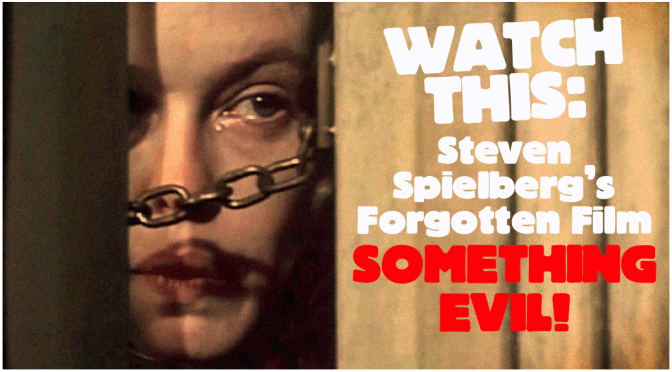
WATCH THIS: Steven Spielberg’s Forgotten Film, SOMETHING EVIL!

This piece originally appeared on Blumhouse.com

Long before Steven Spielberg found his groove directing award-winning biopics and big-budget family films, it seemed like – if only for a moment – the young auteur might settle comfortably into a life of delivering audiences straight-up genre pictures. It may be hard to believe now, young readers, but the sprawling blockbusters we associate with the Spielberg of today are a far cry from the type of stuff he originally helmed when starting out in Hollywood. Like a lot of first-time directors, Spielberg cut his teeth in the business by focusing on the horror, sci-fi, and exploitation genres.

While still a fresh-faced college student who was only midway through his studies at Cal State, Spielberg was offered the opportunity of a lifetime: a 7-year directing deal with Universal Studios. Too good a chance to pass up, he soon dropped out of school to focus on directing full time. The 21-year-old wunderkind’s first directorial effort was an episode of NIGHT GALLERY, and following a string of well-received television credits over the next few years, Universal signed Spielberg to direct four TV films. Continue reading WATCH THIS: Steven Spielberg’s Forgotten Film, SOMETHING EVIL!

SHARK VS ZOMBIE: Ramón Bravo, the Man Behind the Stunt

This piece originally appeared on iHorror.com

Even if you’ve never actually seen Lucio Fulci’s 1979 Video Nasty Zombi 2 (aka Zombie), odds are pretty good that you’re at least familiar with one of its most talked about scenes, wherein an underwater zombie fights and bites an actual shark. This single scene was the main reason I sought the movie out many years ago, and I’m sure that’s the case for a lot of horror fans.

The story goes: Lucio Fulci actually wasn’t too keen on having a zombie versus shark scene, but producer Ugo Tucci insisted after having seen Tintorera: Killer Shark a few years earlier. Tintorera was one of the many cheapo sharksploitation movies that popped up in the wake (sorry) of Jaws. It was a Mexican production, directed by René Cardona Jr., based on the synonymous novel by Ramón Bravo. Continue reading SHARK VS ZOMBIE: Ramón Bravo, the Man Behind the Stunt

WATCH THIS: John Carpenter’s “Lost Film”, SOMEONE’S WATCHING ME!

This piece originally appeared on iHorror.com.

A pretty, sandy-haired young woman is stalked by a mysterious figure; first via car, then by creepy phone calls, and then directly outside her window. He’s even seen in the background spying on her while she converses on the phone. She eventually takes the shadowy figure head-on, stumbling around a living room and fighting for her life, ending with a climax that reveals nothing about the madman’s motivations. Oh, and the whole thing was directed by John Carpenter in the late ’70s. Gotta be Halloween, right? Wrong.

Though it wrapped shooting two weeks before Halloween even went into production, John Carpenter’s television directorial debut, the NBC-produced Someone’s Watching Me! was actually released one month after Halloween. Due to this loopy timeline it’s easy to think Halloween informed many stylistic choices of Someone’s Watching Me!, when in reality it’s the other way around.

Leigh (Lauren Hutton) is an ambitious television producer who moves from New York to Los Angeles. She settles in a large high rise apartment, the kind where the living room is basically one giant window overlooking the thoroughfare. Unbeknownst to Leigh, a creeper who lives in a building across the street spots her and takes a real liking to her. He starts following her, calling her, and leaving her gifts. She continually rebuffs the mystery man, causing him to pursue her more aggressively. With the support of her co-worker Sophie (Adrienne Barbeau) and her boyfriend Paul (David Birney), Leigh goes to the police. Tired of the cat and mouse game, the creep finally attacks.

While not an exact Halloween clone, Carpenter admits SWM! did lay the groundwork for what would become his slasher masterpiece. “A lot of the shots, the framing – and a lot of the flow”, would be reused for Halloween. Carpenter also says, “I got to make mistakes”, referring to the TV movie, which allowed him to hone and sharpen the basic idea and deliver a much leaner and ultimately more frightening movie with Halloween. There are a few familiar Carpenter players in the small cast, namely Adrienne Barbeau and Charles Cyphers. And if you pay attention, you’ll probably spot some names in SWM! that Carpenter would later reuse, including Leigh, Paul, and Officer Tramer.

Noticeably absent from SWM! are a few trademarks Carpenter’s films would come to be known for. He had no input on the score, so here his usual piercing synths are substituted with dramatic, swelling strings – common in ’70s television productions. And his stunning wide-angle lens shots – usually courtesy of Dean Cundey but here provided by Robert Hauser – have been cropped and tightened to fit the 4:3 aspect ratio of a TV screen. Still, the movie displays all the great themes the director would come to be known for, including voyeurism and paranoia.

Watching SWM!, it’s clear that Carpenter who, in 1977, was still new to the horror genre (at that point he only had two feature films under his belt: the sci-fi satire Dark Star, and Assault on Precinct 13, a dystopian Western exploitation flick), was heavily inspired by the works of Alfred Hitchcock – mainly, South By Southwest, Rear Window, and Psycho. At times it feels like it could be entitled Alfred Hitchcock’s Halloween, and I mean that in the best way possible. For a TV movie made in the ’70s, SWM! is incredibly suspenseful and flat-out spooky. The tension builds, keeping you guessing until the very end.

Someone’s Watching Me! is often called “the lost Carpenter film” due to its relative scarcity on home media, but don’t let the hoity-toity label exclude you – I assure you it’s not just for the John Carpenter completest. In fact, I would consider it required Carpenter, especially if you’re a fan of Halloween. It’s one of those special movies that shows its director in transition; especially powerful here since Carpenter’s next film would prove to be his greatest success.

A Look at the Closetsploitation of the ’80s!

This piece originally appeared on iHorror.com.

The first apartment I ever lived in by myself overlooked a graveyard. I’m not exaggerating: you could go out on the back porch, do your best Camille Keaton impression, and literally spit on someone’s grave. So naturally, it wasn’t long before I – a horrornut living comically close to an abounding necropolis – convinced myself that the studio I had just rented was haunted by my new neighbors.

There were a few incidents early on that put this thought in my head – shelf items rearranged, the occasional unflushed toilet – but considering I was in my early 20s – and therefore often existing in a fog of inebriation – I dismissed these manifestations and chalked them up to my own doing. However, there was one thing I knew I wasn’t causing which was impossible to ignore, proof that my apartment was indeed haunted: the living room closet would occasionally smell like spaghetti.

Weird, I know. Silly, sure. But I’m telling you: that living room closet would reek of spaghetti regularly, far too often to be attributed to the downstairs neighbors’ cooking. And the smell was isolated to the closet! How do you explain that? So I assured myself it was haunted by some pasta-loving ghosts. (I liked to imagine they were stoner-type ghosts, specifically; it would explain the constant spaghetti eating and was a far more fun visual than some spooky old woman or Victorian-era child.)

And that’s the great thing about being an adult: I lived next to a graveyard, was convinced my closet was haunted, and it was all somehow very funny to me. But it’s different when you’re a kid. I can’t speak for kids today, but for me – a kid growing up in the ’80s – monsters were very much real, and their favorite places to hide were under the bed and in the closet. And Hollywood – especially during the ’80s – was acutely aware of this.

Prior to this, horror films had shown us closets were a place one might actually consider hiding from the monsters that were after us, but once the ’80s rolled around there was a proliferation of movies that made the closets themselves the genesis of evil – and made us, the viewer, want to avoid them at all costs.

In 1982, Steven Spielberg released two films that featured closets, one more prominently than the other: E.T., which he directed, and Poltergeist, which he only produced. While E.T.‘s closet dealings were charming, cute, and brief, the closet in Poltergeist was anything but. It was a literal door to Hell. Sure, the infamous staticky T.V. was spooky and all, but let’s not forget: The Freeling’s troubles really began once poor little Carol Anne was sucked into her bedroom closet. And look, once Steven Spielberg does something unique (and quite successfully, I might add), a string of imitators are guaranteed to follow. And follow they did.

Long before J.J. Abrams learned to purloin from the king, Roland Emmerich (Independence Day) was doing his best Spielberg impression with Making ContactAKA Joey, a film littered with references to Close Encounters of the Third KindE.T. and Poltergeist: broken suburban family, toys that spring to life, telekinesis, creepy puppets, good vs evil. Oh, and spooky closets. Here again, the closet acts as a portal to another dimension, one wherein our lead, Joey, is able to communicate with his dead father. Watch the trailer and I’m sure you’ll agree: this is the most Spielberg movie ever made (that Spielberg didn’t actually have any involvement with).
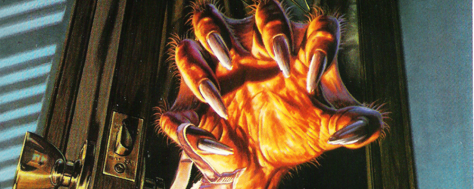
Unlike Making Contact, Monster in the Closet is a low-budget offering (from schlockmeisters Troma) which is more spoof than imitation Spielberg, paying homage to the creature features of the ’40s and ’50s – but make no mistake, this is pure closetsploitation. The film finds a small town being terrorized by a monster who accesses their homes via their closets. The only way to stop it? Destroy every closet in town, naturally.

The beloved Fred Dekker/Shane Black film The Monster Squad sees our titular club of preadolescents saving their small town from a group of invading monsters straight off the Universal Studios backlot circa the 1930s. All the big names are present: Dracula, Frankenstein (‘s Monster), The Wolf Man, The Creature, and of course, The Mummy. Dekker – no stranger to cramming as many horror tropes as he can into his films (see: Night of the Creeps) – doesn’t miss the opportunity to insert the ol’ monster in the closet gag in Squad, with a youngster trying to convince his half-awake dad that The Mummy has taken up residence with his empty hangers.

If Making Contact is the most Spielberg movie that Spielberg never made, then Lady in White is easily a close second. It, too, features many allusions to Close Encounters, Poltergeist, and E.T. – including a scene where a kid on a bike seems to defy gravity and “fly” over a ravine. And yes, it even features an other-worldly closet, this time in a school, in which our young lead Frankie (Lukas Haas) finds himself locked after hours. It is here that he has ghostly visions of a girl being murdered by a strange man in the very same closet he’s trapped. Frankie spends the rest of the film trying to solve the crime, and revisiting the creepy closet for clues.
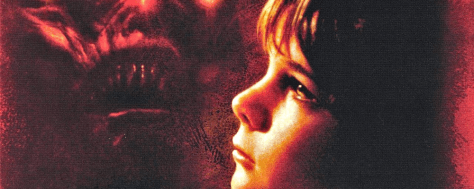
And finally we have Cameron’s Closet, a movie in the same vein as Making Contact and Lady in White, albeit it a tad more violent (and a lot racier). Unbeknownst to our telepathic protagonist Cameron, his favorite toy is actually a possessed Mayan doll – one that comes to life (due to Cameron’s active imagination) and begins residing in his closet. And wouldn’t you know it? The doll begins killing people who come near the closet, turning them into demon zombies. Typical. As I said, this is a bit more brutal than your average closetsploitation fare, but the Spielbergian hallmarks – telekinetic kid, toys springing to life, flashing lights – are all there. Oh, and Oscar-winning special effects maestro Carlo Rambaldi – who worked on both Close Encounters and E.T. – did the special effects for Cameron’s Closet. There’s no denying the intentions of the filmmakers.

The decade saw many other inclusions of closetsploitation – some of it brief, some of it not even in the film but merely used in the marketing. Even television shows got in on the excitement. And while there have been nods at closet horror in the decades since, nothing compares to the boom of the ’80s.

This is only a brief rundown of some of the films from that era that made our closets terrifying. Which ones am I missing?

THE MISSING “CREEPSHOW” MUSIC CUES!

Based on sheer unanimous appreciation alone, Creepshow may be one of the greatest horror films ever made. Truly: I’ve never heard one disparaging comment made about it. Inquire, and those who’ve seen it will excitedly describe their favorite segment, their eyes alight and hands animated. For those raised on it, it’s like a plateful of comfort food. And, due to its fall-tinged intro, it has become a Halloween staple. Needless to say, it’s a horror classic.

One of the things that helped cement Creepshow among horror royalty is its incredible score. Composed by frequent Romero collaborator John Harrison (using only a Prophet V synthesizer), the score successfully manages to craft a hauntingly Gothic aura punctuated by goofy camp – no easy task, but one that compliments the vibe of the comic book-inspired film perfectly. Romero himself has said that Harrison’s score delivers on the promise the tagline of the film avows: “the most fun you’ll have being scared”. Continue reading THE MISSING “CREEPSHOW” MUSIC CUES!